
Pigeons gather in a square in Barcelona.
Note: Pigeons and doves form the bird family Columbidae, of which there are 300 species. Ornithologically, there is no simple way to distinguish a pigeon from a dove. Some specialists refer to the smaller species as “doves” and the larger ones as “pigeons,” but this is not consistently applied.

Collared doves can be tamed in urban areas, such as these two sweeties being handfed in Poland.
In reference to the works of Spanish artist Pablo Picasso, the issue is further muddled. The titles of many of his works include the Spanish word la paloma, which means both “pigeon” and “dove,” so we aren’t sure which bird he intended to depict, if, indeed, he did intend to create such a distinction.
Finally, Picasso biographers, art curators, and translators have added their own layers of confusion. For example, the painting, “Child Holding a Dove,” (National Gallery, London) has been given two different French title translations: “L’Enfant A La Colombe” (Child With the Dove) and “L’Enfant Au Pigeon” (Child With A Pigeon).
Therefore, for the purpose of this article, the terms, “pigeon” and “dove,” are used interchangeably, as is common practice, except when otherwise explicitly stated.
Now for our story:
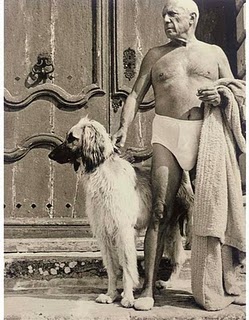
“Picasso in Underwear,” photo by David Douglas Duncan, 1957. From the earliest age, the most famous artist of the 20th Century did whatever he wanted, which might include posing in his jockeys on his front doorstep at age 76.
Famed Spanish artist Pablo Picasso (1881-1973) grew up around pigeons. His father, José Ruiz Blasco, an artist in his own right, bred pigeons (rock doves), which became his favorite subject to paint. Ruiz became known as El Palomero (The Pigeon Fancier). Pablo’s father taught him how to paint pigeons. (1)
In Pablo’s hometown of Málaga, Spain, pigeons roosted in the sycamore trees in the Plaza de la Merced, where he and his sisters played. While the girls frolicked in the square, Pablo used a stick to make bird drawings in the dirt. (2)
Much to the dismay of his elementary school teachers, Little Pablo, or “Pablito,” drew constantly. Every once in a while, he brought a pigeon to class and spent his time sketching it rather than doing his assigned schoolwork.

Pablo used every inch of his drawing paper, covering the page with scenes of his favorite subjects: bullfights and pigeons. (3)
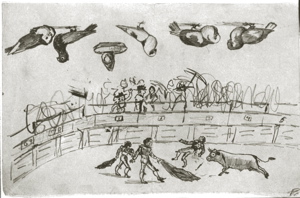
Guided by his father, Picasso received professional art instruction. His talent grew and was recognized. By the age of 15, he was successfully exhibiting his artwork. By 1901, he was splitting his time between Barcelona and Paris, falling increasingly in the company of artists heavily influenced by post-impressionists such as Vincent Van Gogh.
That same year, at the age of 20, Picasso had become so respected an artist that he had a Paris show in the Galerie Vollard almost to himself, sharing it with another Basque. At this exhibition, Picasso
sold 15 of his 65 paintings and drawings before the exhibition had even opened.” (4)
Through all these changes, however, pigeons still charmed him, as is evident in his sentimental 1901 painting, “Child Holding a Dove” (1901), a piece that ushered in his somber Blue Period.

Pigeons even appeared during his cubist period, as in “Woman With Pigeons” ( 1930).

“Woman With Pigeons,” by Pablo Picasso, 1930.
Before 1937, Picasso had not used his art for political expression. It was in that year, though, that he was to create his most famous work. Commissioned by the Spanish Republican government, Picasso created an enormous mural called “Guernica.” It was named after a Spanish town in the Basque country that had been firebombed by Nazis, backers of the Nationalist forces of General Franco during the Spanish Civil War (1937-1939).
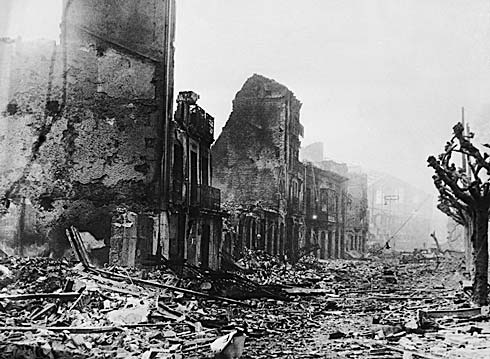
Guernica, Spain, after the April 26, 1937, aerial bombing by Nazis. It was market day and the quiet village was filled with women and children. There were few men left in Guernica, as most were off fighting in the Spanish Civil War against Franco. The Nazis bombed the town for two hours, slaughtering hundreds of innocents. When the town caught fire, those not burned to death tried to escape the inferno by taking refuge in the outskirts of town. Yet there was no escape, as they found themselves trapped all around by bombed-out bridges and roads. Some of these women and children were gunned down by aerialists. The Nazis supported the rebel forces of General Franco to test out war tactics and weapons. Although there was a military target outside Guernica, a munitions factory, it was left unscathed by the April 1937 bombing. It is believed that the bombing was used to intimidate those in opposition to Franco’s impending rule.
After the painting “Guernica” (see below) was exhibited in the Paris International Exhibition (1937), it toured Europe and the U.S., drawing international attention to the Spanish Civil War and the horrors of war.

“Guernica,” by Pablo Picasso. (1937)
“Guernica” gained monumental status, becoming a potent anti-war symbol and thrusting Pablo Picasso to the forefront of the Peace Movement. In May of 1940, Hitler invaded France. Throughout WWII, Picasso lived in Nazi-occupied Paris, where he was continually harassed by the Gestapo who were familiar with his anti-Nazi mural.
Picasso continued to paint and draw pigeons and doves. In 1949, author Louis Aragon chose the artist’s lithograph, “La Colombe,” (The Dove) for the poster commemorating the Peace Conference in Paris. (5)

“La Colombe” (The Dove) by Picasso, 1949
Posters of “La Colombe” were all over Paris when Picasso’s daughter was born that April so he named his daughter Paloma (Spanish for dove).


In this 1951 image, Pablo Picasso is shown with 2 of his 4 children, whose mother was Francoise Gilot: Paloma (b. 1949) in his arms and Claude (b. 1947) Photo Edward Quinn, © edwardquinn.com
The model for the famous “peace dove” was one of artist Henri Matisse ‘s doves.

Henri Matisse in his studio with his doves. Vence, France. 1944. photo by Henri-Cartier Bresson
Matisse and Picasso had known each other since 1904 when they were introduced at the Paris salon of Gertrude Stein, an important collector of art, particularly Matisse’s. Matisse and Picasso had a profound influence on one another and their art.
After Matisse died in 1954, Picasso was deeply saddened. He moved his family to a large villa near Cannes in the south of France and painted a series called “Studio” in homage to Matisse. He painted almost a dozen canvases of the same view from his third floor studio window – with the lush background of sky and garden and sea – while, in the foreground, “white doves” (6) nested and played in a dovecote Picasso had built on his terrace. Picasso did not ordinarily paint what he saw; he drew upon his imagination for artistic inspiration. It was his old friend Matisse who drew from nature. Therein lay Picasso’s tribute to Matisse.
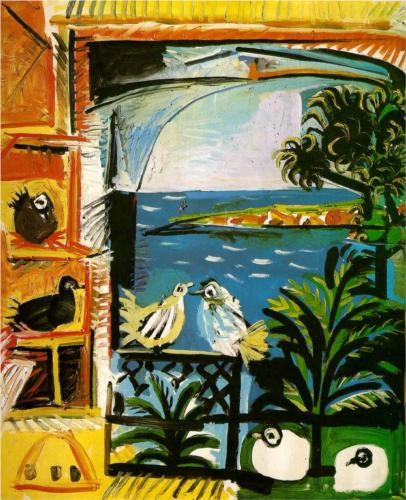
“The Studio (Pigeons),” by Picasso, 1957, is painted in a style reminiscent of Matisse.
Meanwhile, the “Dove of Peace” Picasso had created for the 1949 Paris Peace Conference had caught on. It had become a symbol for the peace movement, the Communist Party, and other liberal groups. In the years that followed, Picasso agreed to create other peace doves for conferences across Europe.
The modern peace dove is a more whimsical bird than the 1949 original. This proud bird is portrayed in happy flight, bearing numerous bouquets of olive branches and flowers in its wings, beak, and feet.

one of the many versions of Picasso’s iconic “Dove of Peace”
(1)”Lines That Kept Moving and Knew No Boundaries,” by Smith, Roberta. New York Times, October 7, 2011.
(2) Hart, Tony. Famous Children: Picasso. New York: Barron’s Educational Series, 1994.
(3) Krull, Kathleen. Lives of the Artists: Masterpieces, Messes (and What the Neighbors Thought). New York: Harcourt Brace & Company, 1995.
(4) link
(5) Clark, Hiro. Picasso: In His Words. New York: Welcome Books, 2002.
(6) Douglas, David. Viva Picasso: A Centennial Celebration 1881-1981. Studio, 1980.










 Lisa's History Room
Lisa,
Once again, I find myself in your debt. Your post encompasses the story of a deep friendship between my two favorite artists, the environmental influence behind an iconic artistic motif, and the interplay between the harsh realities of war and visual achievement in the 20th century. Thank you, once again, for making my world richer and more coherent.
Sincerely,
Shirley
LikeLike
Shirley, I keep this blog going due to kind people like you. I’m glad the subject matter was on point. I prefer writing about women but Picasso is too intriguing to pass up. I think he was several people cased in one body. Thanks for the kudos. Lisa
LikeLike
High Lisa
I hope you still keep your blog going because I need your help. May be you can help me in my search of the location (or owner) of the original Picasso’s “Flowers of peace” dated 21.4.58. I did search on various sites and using different search engines and none came up with adequate answer. I wonder how was the original painting made (oil on canvas, water color, or anything else. Could not find any history of the original painting. Would appreciate very much if you can help me.
Thank you
Len
LikeLike
Len, perhaps you should contact a museum with Picasso holdings.
LikeLike
Thank you. There are so many in various places. I’ve checked with several in US (including art galleries) and could not find any trace. May be you can suggest some.
LikeLike
Hi Lisa,
Thank-you very much for the return of your posts!
I’m relishing this Picasso (mini?) series.
His works seem to come from a different world and after seeing them I usually feel a little dazed– do modern historians have any ideas on why he saw the world like that? (Probably it can’t be explained, but it’s fascinating nontheless.)
Thanks again!
Jess
LikeLike
Picasso was always changing his art style – he kept us guessing, didn’t he?
LikeLike
Love this topic you’ve chosen. It’s wonderful to see the peace dove is one of picasso’s point of references in his time of expressing himself for the beauty of god and nature..very impressive colors on the madonna holding the dove as well the child with the dove in her hand. lovely meaning…Comes across everytime in his painting, he brings with him many avenues ….
LikeLike
Picasso and Matisse had a mutually fuelling relationship. You have posted a very good description of this most fertile font of creativity. My congratulations.
LikeLike
Dhiraj, there is so much more I need to learn of their relationship!
LikeLike
Just stumbled on you via a google search, “Picasso doves” 🙂
Thank you. Most enjoyed this post.
LikeLike
I bought a diamond dove for a pet and named him “Pablo.”
LikeLike
That’s an Australian dove! 🙂
LikeLike
I know! He just sits and occasionally hoots.
LikeLike
Ah, just like some of my country-people I know then….
LikeLike
[…] Рекомендую заглянуть на https://lisawallerrogers.wordpress.com/2011/09/26/picassos-peace-dove/ […]
LikeLike
Whatever happened to the ORIGINAL “modern peace dove” painting? Is it hanging somewhere in a museum? Or is it MIA (missing in action)?
LikeLike
at the Museum of Modern Art, NYC: http://www.moma.org/collection/object.php?object_id=60633
LikeLike
[…] https://lisawallerrogers.wordpress.com/2011/09/26/picassos-peace-dove/ […]
LikeLike
Where is the original la Colombe dove, how do I tell if mine’s the original? It looks pretty authentic, even the frame and the stamp on the back..
LikeLike
Picasso drew many versions of the peace dove. I imagine there are several provenances. Cherish the one you have!
LikeLike
This is a beautiful blog! Child with a Dove evokes so many memories for me as my Grandparents had a print of it in their home. It’s wonderful to read this history of Picasso’s peace dove.
LikeLike
[…] To learn more about Picasso’s work that features doves please click on the following link, Picasso’s Peace Dove. […]
LikeLike
[…] Fun fact: Picasso father was a skilful painter and pigeons were his most common subjects. They later also popped up in Picasso’s works (read more here) […]
LikeLiked by 1 person
I have a Picasso drawing drawn in blue of a Dove of Peace, signed and dated 4.5.58. Can you tell me something about it and if I should have it appraised and insured? I love the meaning of the drawing.
LikeLike
[…] Fast-forward a few milenia to post-war France. Pablo Picasso lived in Nazi-occupied Paris for the duration of World War II and the experience hardened his position as an avowed pacifist. Peace organizations flourished after the War and were eager to engage Picasso and reap the benefits of his celebrity. The First International Peace Congress chose Picasso’s life-like lithograph “La Columbe” as it’s emblem, thus reafirming the dove as a symbol of peace in the modern era. His later renditions of doves were simple line drawings of the bird with a single olive branch in its beak or with colored flowers and an olive branch. These dove drawings became widely associated with the global Peace Movement in the early 1950s and remain among his most popular works today. (See those images here) […]
LikeLike
My wife, holder of masters in fine arts and Picasso lover, recently said she would love to have a Picasso Peace Flag. Can you give me some guidance, there seem to be so many examples of Picasso’s Peace Doves and I’m not finding this flag she refers to. Thanks!
LikeLike
Could it be this foulard: Commemorative foulard Festival Mondial de la Jeunesse et des Estudiants pour la Paix, 1951 Berlin
_______________________ Edward Quinn Archive Ltd. Wolfgang and Ursula Frei Oetwilerstr. 29 CH-8634 Hombrechtikon Switzerland archive@edwardquinn.com http://www.edwardquinn.com Tel. +41 44 926 70 94
_______________________ Please visit our website http://www.edwardquinn.com
>
LikeLike
[…] Picasso was born in Malaga, Spain in 1881. His father was an artist, who happened to like painting pigeons or doves. Picasso’s early paintings were not necessarily political in nature, and he gained quite a […]
LikeLike